We've seen this movie before. A new technology arrives, demos dazzle, VCs pour in money, and everyone declares a revolution. Then the bill comes due.
June 2026 is the month the bill arrived for AI. OpenAI and Anthropic are racing to IPO not because they've solved general intelligence, but because their private funding models are structurally exhausted. Meta is building data centers in tents in Ohio because traditional construction can't keep pace with GPU demand. Alberta is fielding proposals for 13.2 gigawatts of data centre capacity (equivalent to multiple nuclear plants) while communities push back on water use and noise. Cloudflare reported that bots, led by AI agents, tipped past human web traffic for the first time in early June, well ahead of its own forecast, forcing a reckoning about what the web even is when machines are the primary users.
“The winners of the next AI wave will be the people who turn hard capability into usable structure. Not the loudest prompt sellers. Not the most decorative wrappers.”
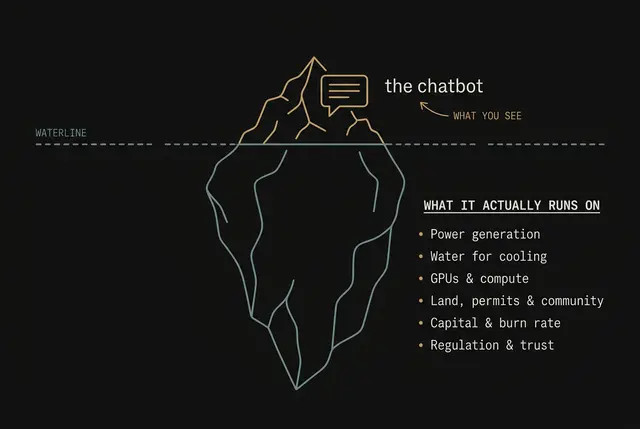
The emerging trend isn't any single product or model release. It's the shift from AI as interface to AI as infrastructure: boring, expensive, regulated, physically constrained infrastructure. The best-positioned companies aren't necessarily the ones with the smartest chatbots. They're the ones solving compute bottlenecks, building data centers that communities will actually accept, standardizing how agents interoperate, and figuring out how to deliver AI in regulated environments where trust and auditability matter more than benchmark scores.
Canada is interestingly positioned here. We don't have a hyperscaler of our own, but we have energy, land, research talent, and a government that just explicitly named sovereignty as a strategic priority. The "AI for All" strategy's most consequential move might be the VITAL health platform: federated analytics that runs on provincial datasets without centralizing sensitive data. That's infrastructure thinking. It's unsexy. It won't go viral on Twitter. But it's the kind of architectural decision that determines whether AI adoption actually happens at scale or stalls at the pilot stage.
In 12 months, the companies still standing won't be the ones with the best demos. They'll be the ones that solved a real workflow for a real buyer, with real governance, at a real margin. Everything else is marketing.
The Skeptic's Take
Infrastructure is where hype goes to die slowly. Canada's data centre boom in Alberta is running on natural gas, which means we're building "sovereign AI" on a foundation that undermines our climate commitments. Meanwhile, the tent data centres have a lifespan measured in months, not decades: fast to deploy, expensive to maintain, brittle in Canadian winters. The infrastructure shift is real, but a lot of what's being built today will be stranded assets by 2028. Bet on the companies that solve the energy and governance problems, not the ones throwing up the most server racks the fastest.